
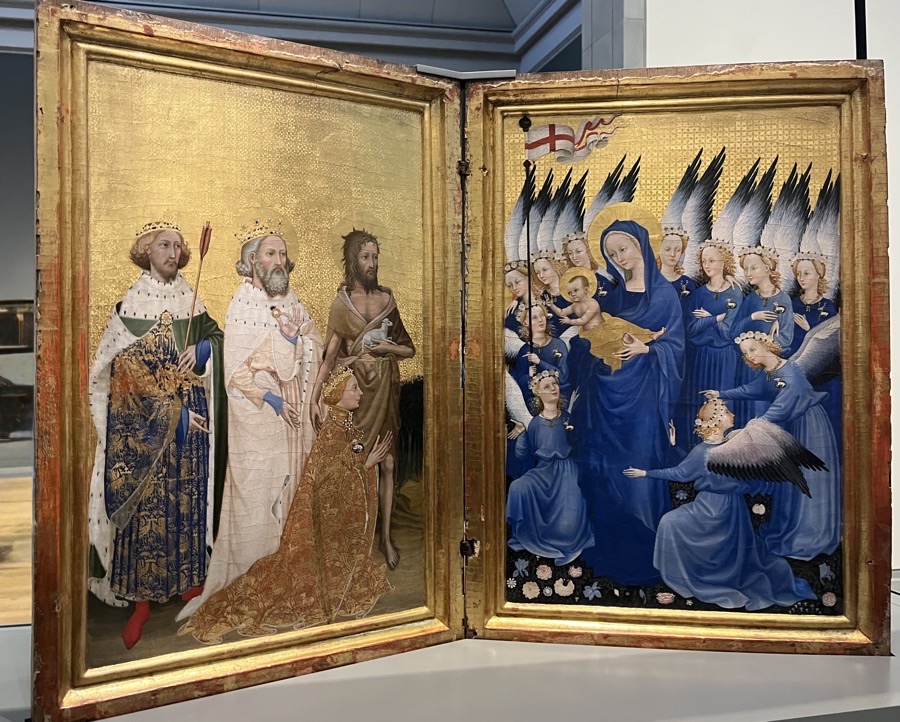
The painter to this shimmering panel painting remains a mystery, its owner anything but, destined for the big headed King Richard II. The first monarch to demand the title of ‘Your Majesty’
The Wilton Diptych (from the Greek to fold in two), gets the first half of its name from time spent in the wonderful Wiltshire town. Made by mixing paint with egg tempera (from the latin, meaning to mix), applied directly onto oak, this form of painting goes back a millennia. The image is plain, the king kneeling before the infant Christ.
It quietly blows my mind that Richard was England’s first English speaking monarch in over 300 years. His forebear William I ‘The Conquerer’ had brought with him French to the royal court of England. How did the English language survive? Like a lesson in life for us all, it showed resilience, it soaked up the changing world around, morphing from a German tongue that I for one, would need an interpreter to decipher. Richard would’ve settled down at a halfway house called Middle English, still distinct from our chatter today. A classic tale of the underdog.
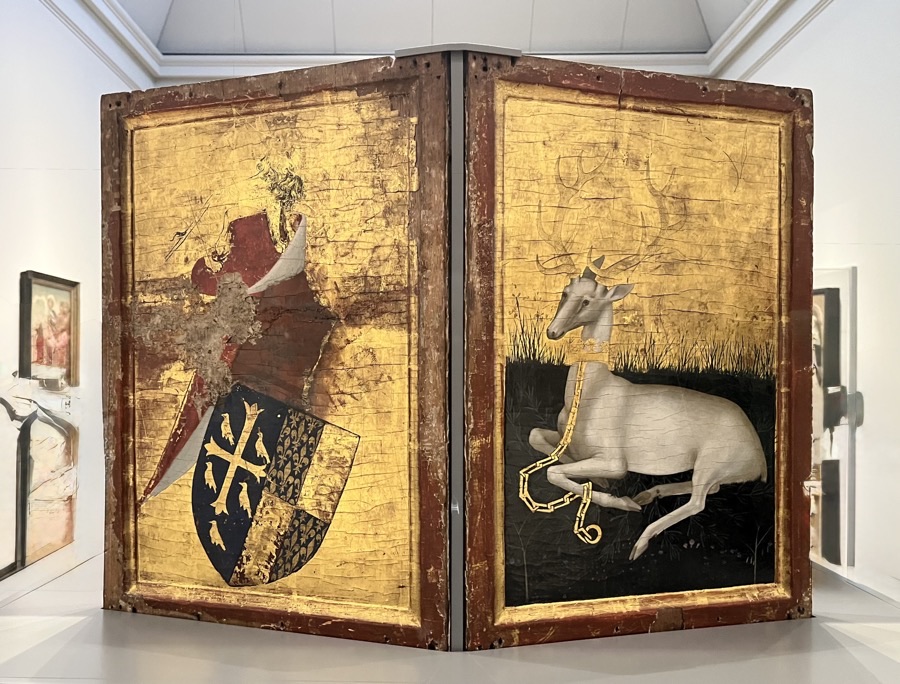
Just after this work was complete, intended for the king’s private devotion, Richard called his wonderfully named Revenge Parliament of 1398. The very next year he spectacularly fell off his throne, winding up being starved to death in a dungeon by order of his cousin. Is it any wonder Shakespeare had so much fun with his words, with entitled kings like Richard II to draw from.
As Richard’s body quickly decayed, believing himself destined to soak-up a sumptuous afterlife, what remained is something of a miracle; how did this religious work of art survive 600 years, unscathed through civil wars and Puritan destruction.
Whatever the reason for its survival, as I gaze through toughened glass, a stillness pervades amidst the din of the gallery. There, in an instant, the painter, the king and I span the centuries.
The Wilton Diptych. On display at The National Gallery, London.